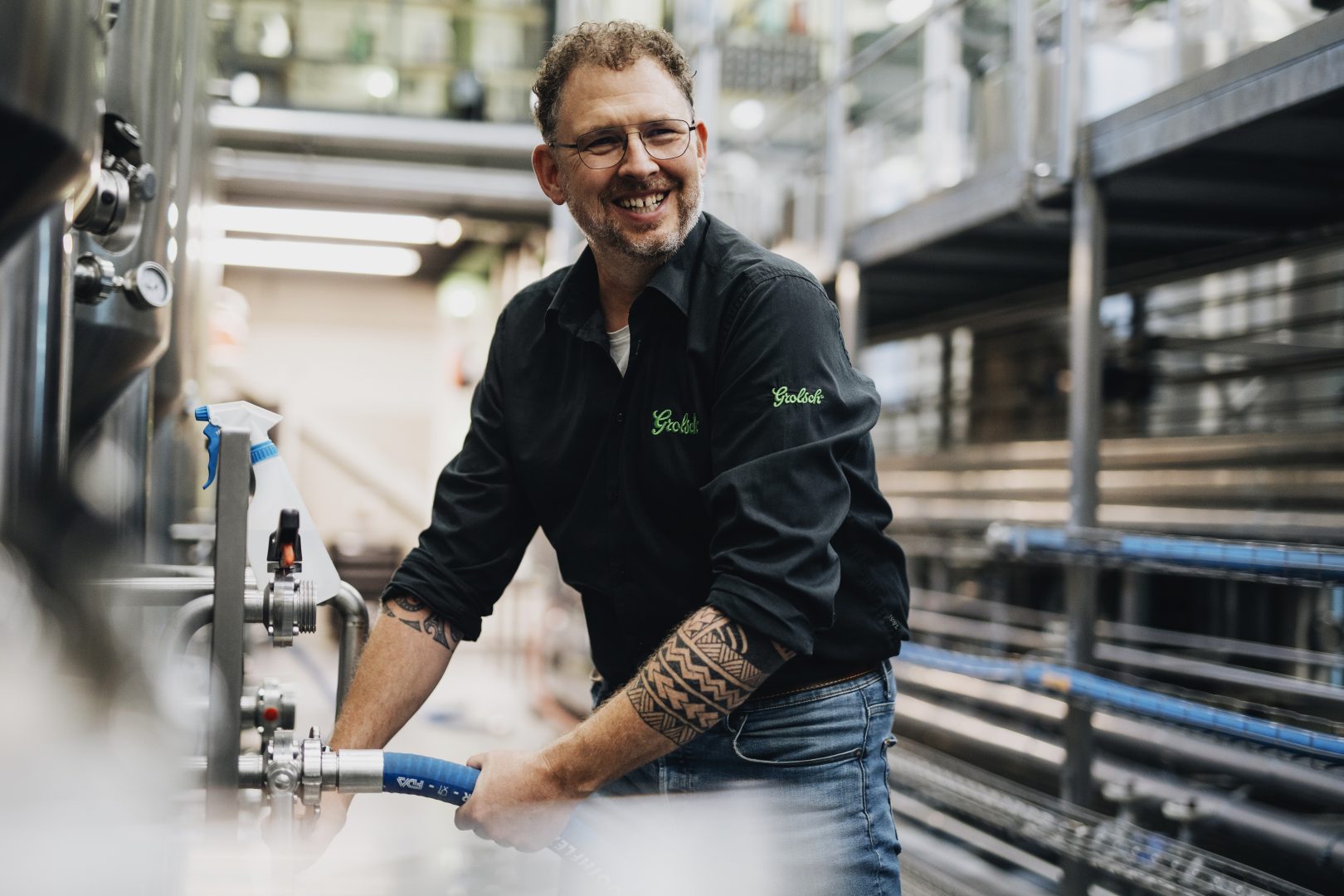
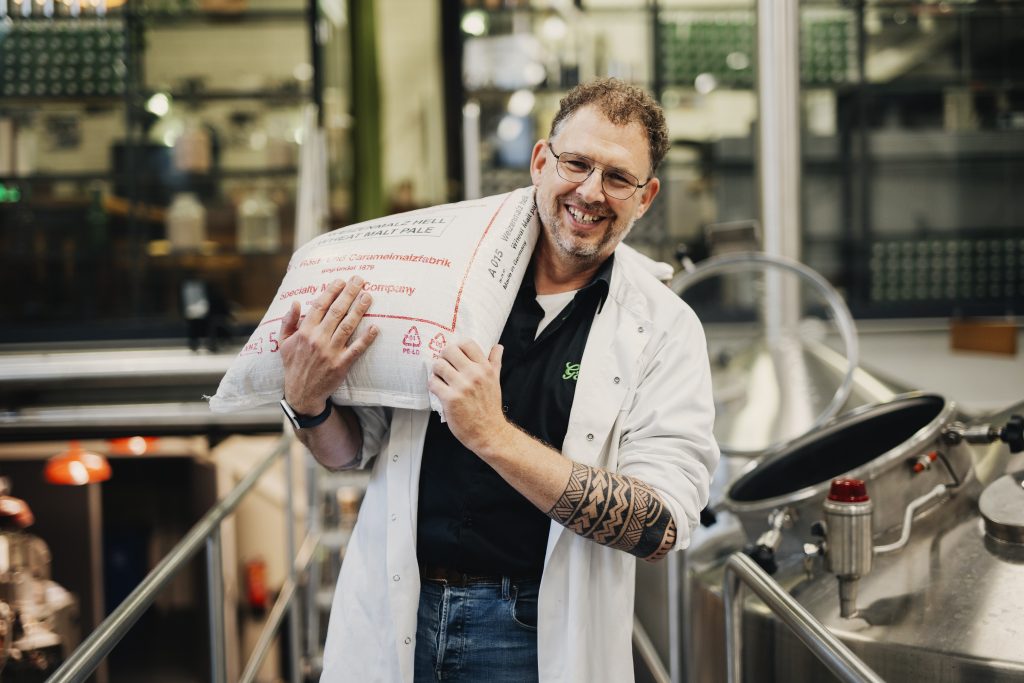
It almost seems inevitable, in hindsight, that Marc Janssen would one day become master brewer at Grolsch. Not only because of his love for beer and flavor, but also because of his background. Both his father and grandfather worked at the brewery in Enschede long before him. Grolsch was therefore part of his world early on, though Janssen himself never saw it as a predetermined path. “It’s not like I knew from a young age that I would become a brewer,” he says. “But the environment, the stories, and the fascination with how things are made were always there.” That combination of proximity and curiosity would later shape his approach to the craft. Especially at a brewery where tradition is not only something you preserve, but also something you occasionally have to push against.
A detour that set everything in motion
Remarkably, Janssen’s career at Grolsch did not begin immediately after finishing his studies, but during a sabbatical in 1995. A year intended as a step back turned out to be the moment everything moved forward. “That sabbatical was really the turning point,” he recalls. “I ended up at Grolsch and realized how fascinating brewing actually was to me. Not just the product, but especially the process behind it.” What started as a temporary step grew into a career in which education, training, and professional experience followed one another. The craft became broader, more complex, and increasingly intriguing. “The more you learn, the more you realize how much there still is to discover.” That mindset, continuing to learn and continuing to question, still sits at the heart of how he works today.
Master brewer: a role defined by decisions
The title master brewer may sound romantic, but in reality the role is defined by responsibility. Janssen safeguards recipes and quality, while also guiding processes, teams, and collaborations across the brewery. “It goes far beyond what happens in the brewhouse,” he says. “You’re constantly making decisions.” Tradition plays an important role in that process, but never as something rigid. “Tradition gives direction, but it shouldn’t become a brake. Just because something has always been done a certain way doesn’t mean it always has to be.” For Janssen, a beer is only finished when everything falls into place. “That’s difficult to capture in rules,” he admits. “But you feel it. When you no longer want to add anything, and also can’t take anything away.”
The seed of Ondersteboven
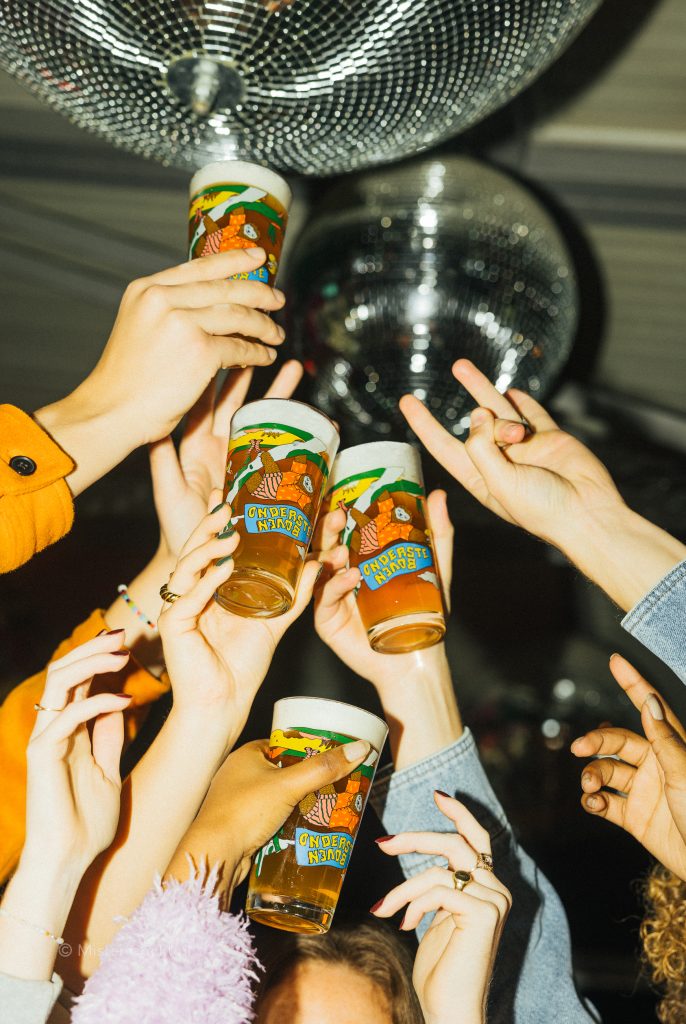
The idea for Ondersteboven did not emerge from a tightly structured innovation plan, but from a feeling. The sense that there was room within the Grolsch portfolio for beers less bound by expectations, and perhaps a little less serious. “I was missing beers that are playful but still balanced,” Janssen says. “Not extreme, not shouting for attention. Beers you drink because you feel like it, not because they come with a manual.” Ondersteboven was therefore conceived as a fun, slightly rebellious brand. For people who enjoy turning things upside down every now and then. For beer drinkers, but explicitly not for beer geeks.
The name quickly became more than just a label. It became a mindset. “It was about turning things around. Questioning assumptions. Seeing what happens when you approach processes or flavors from a different angle.” Within a large brewery that still means working within certain boundaries. Yet those boundaries, Janssen says, ultimately sharpened the process. “They force you to make very deliberate choices.”
From idea to character: Disco Daisy and Hangende Harry
The different beers within Ondersteboven emerged through a process of experimenting, adjusting, and tasting again. Not from rigid style definitions, but from intuition and the moment in which the beer might be enjoyed. “Sometimes you start with a flavor idea, sometimes with a technique,” Janssen explains. “And sometimes you mainly know what it shouldn’t be.” That’s how Disco Daisy and Hangende Harry came to life, beers with distinct personalities but without an overly complicated story. Disco Daisy is light, playful, and inviting. Hangende Harry carries a little more edge and character without becoming heavy. The names themselves are intentionally irreverent, and the beers follow the same spirit. “Some beers actually had to become simpler,” Janssen says. “Others only gained character once we added something. But the goal was always the same: balance.” Yeast, malt, and hops each play their role, but never to dominate the story. “It shouldn’t become a technical narrative in the glass,” he says. “Everything is ultimately in service of drinkability.”
For people who simply want a good beer
Ondersteboven is aimed at people who drink with curiosity, but without the urge to analyze every detail. “You don’t need to be a beer expert,” Janssen says. “You just need to feel like having a good beer.” Drinkability remains central. “You should want another one. That might be the most important criterion of all.” These are beers designed for a range of moments, a casual drink, a party, an evening with friends. Not beers to endlessly debate, but to enjoy together. “Ideally someone takes the first sip and thinks: this works. And by the second sip: let’s have another.”
Beer, the market, and responsibility
The Dutch beer market has matured significantly over the past decade, Janssen observes. “Ten years ago it was much more about extremes. Now it’s more about balance, quality, and credibility.” Large breweries, he believes, have an important role to play in that shift. “Not just following trends, but helping shape them. And also showing that beer doesn’t always have to be complicated.” Ondersteboven fits squarely within that vision. Not a marketing trick, but a considered choice. “It shows that even within a large brewery you can continue to experiment, as long as you take it seriously.”
Understanding the rules so you can turn them upside down
What Janssen is most proud of is not one specific beer, but the process behind it. “That we gave ourselves the space to search, to doubt, and to get better.” His advice to young brewers follows naturally from that philosophy. “Learn the rules. Understand them. And then dare to consciously turn them around every now and then.” Because sometimes you need to turn things upside down first to see clearly again what beer is really about: enjoyment, flavor, and the right moment.
Onderstebovebn is only available in bars across The Netherlands, find the closest bar on their website.