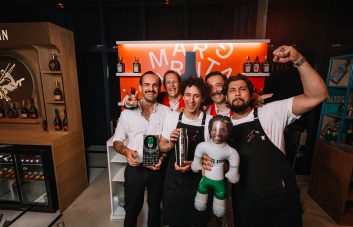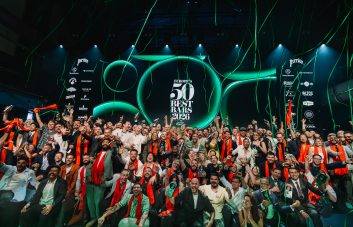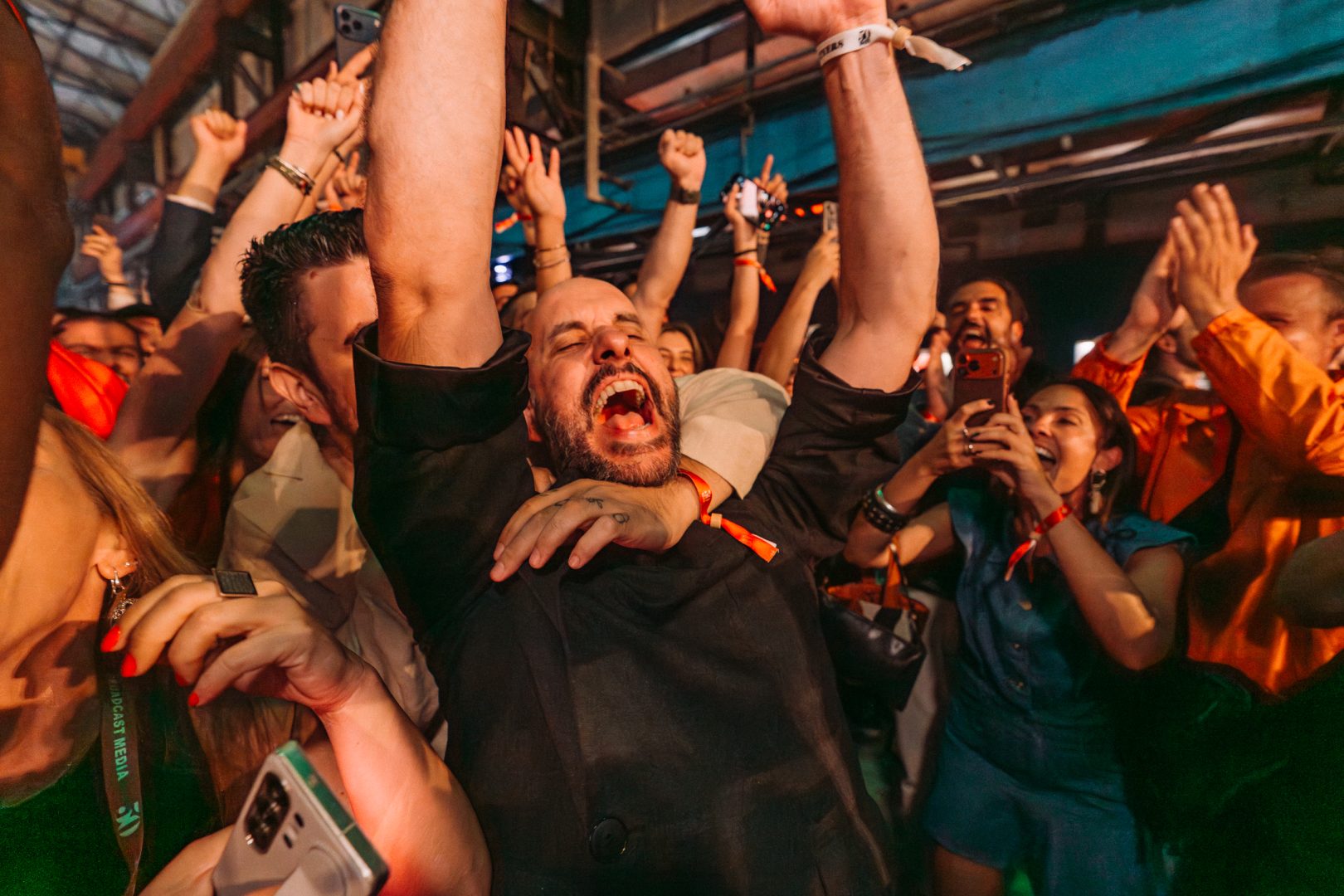
Line sits inside a former art gallery in Kato Petralona, all soaring ceilings and industrial bones, and until 30 June it was best known internationally as the bar that landed at No.8 on The World’s 50 Best Bars 2025. Then Europe got its own list. Line took No.1. For a bar that was already on the global radar, this wasn’t a discovery story. It was a coronation. Which makes the obvious magazine question, the one every outlet is going to ask this month, the wrong one. Nikos Bakoulis, co-founder alongside Vasilis Kyritsis, doesn’t have a neat answer for “what changed”, because from where he’s standing, almost nothing did. “From our side, nothing dramatic changed at Line, and maybe that is exactly the point,” he says. “We did not rebuild the bar to chase a position.”
What he offers instead is a slower explanation, one that has more to do with time than tactics. “At the beginning, many people saw us mainly through fermentation, fruit wines, sustainability, or technique,” he says. “Over time, I think they started to see the whole picture: the drinks, the food, the service, the atmosphere, the team, and the way all these things connect.” It’s worth remembering what’s actually driving that list: Europe’s 50 Best runs on the same model as its global counterpart, an anonymous panel voting on personal opinion rather than a fixed scorecard. There’s no checklist a bar can tick off. Bakoulis, to his credit, doesn’t pretend otherwise. “It is impossible for me to say what changed in the mind of each voter,” he says, “and I also think it would be wrong to treat the list like a mathematical result.”
Words & pictures by Albert van Beeck Calkoen
Consistency in a system that refuses to sit still
Line’s whole identity runs on fermentation, on turning byproducts, fruit skins, spent grain, whatever the kitchen and bar would otherwise throw out, into the next thing on the menu. It’s a compelling story in a press release. It’s a genuine operational headache behind the bar, because the raw material is never quite the same twice. Bakoulis doesn’t dress this up. “We once brought a byproduct-based ferment into service before it was fully ready,” he says. “The idea was right, but the liquid was still changing too much from day to day, and the drink needed too much explanation. Some guests understood the concept, but the flavour was not clear enough.” That failure reset how the team thinks about the whole concept. “Sustainability is not enough by itself,” he says. “A drink has to be delicious first, stable enough for service, and generous to the guest. Circularity should not feel like a lecture. It should feel like hospitality.”
So how do you train a team to deliver something consistent when the ingredients themselves are moving targets? Bakoulis reframes what consistency even means. “Consistency for us does not mean forcing every batch to taste exactly the same,” he says. “It means giving the guest the same level of balance, care, and hospitality, even when the raw material changes.” Every batch starts with the team tasting together, discussing what’s shifted, deciding whether an adjustment is needed, while the fundamentals, balance, temperature, dilution, glassware, service, stay fixed. “The aim is not to hide variation,” he says. “It is to make sure variation never becomes confusion for the guest.”
Structure versus instinct
Ask Bakoulis where he and Kyritsis actually disagree, and he won’t hand you a rivalry narrative. The two co-founders want the same outcome. Where they push against each other is on how much of the bar should be designed and how much should be left to instinct. “A bar needs structure, standards, and consistency, but it also needs freedom and emotional intelligence in the room,” he says. “Hospitality cannot become mechanical. So we challenge each other on how much we define and how much space we leave for the team to read the guest and the moment.” It’s a tension that shows up again in one of the more candid admissions in this conversation. Guest feedback over the past year told the team something uncomfortable: the concept behind Line was landing, but the delivery of it wasn’t always. “For some guests, the idea behind Line was very interesting, but sometimes the way we communicated it felt too technical,” Bakoulis says. “They enjoyed the drinks, but they did not always need to hear every detail about fermentation, byproducts, or process before simply enjoying what was in the glass.” That wasn’t a one-drink fix. It changed how the whole menu is written and how the team talks through service. “We try to start more from flavour, feeling, and hospitality, and then go deeper if the guest wants to know more,” he says. “Knowledge should support the experience, not stand in front of it.”
What a Greek sweep actually does for Athens
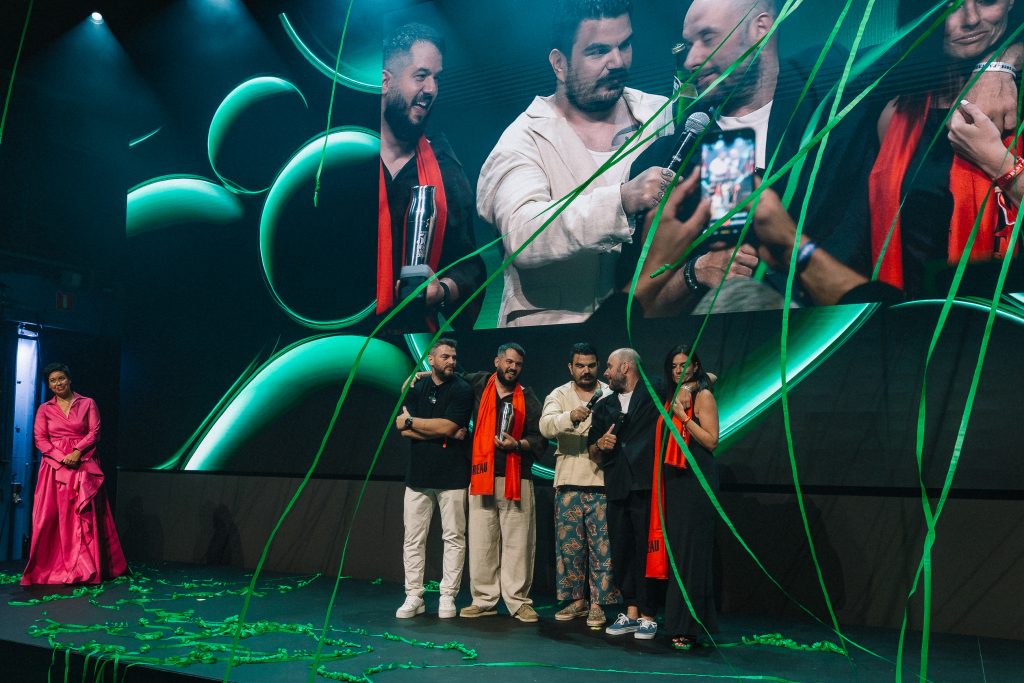
Athens didn’t just place one bar on this list. Line took No.1, The Bar in Front of the Bar took No.2, and Greece landed five bars in the top 50 overall. Bakoulis is careful not to make this only about the two bars at the top. “I think the biggest effect is that it gives Athens more confidence as a hospitality city,” he says. “Not only for the bars that are on the list, but for younger bartenders, small independent places, suppliers, producers, farmers, chefs, and people who are thinking about opening something here.” He points to something bigger than the ranking itself: Greek hospitality professionals showing up inside influential bars across Europe, not just in Athens. “That shows something bigger than one city or one list,” he says. “It shows that Greek hospitality has a voice outside Greece as well.” But he’s not treating the moment as self-fulfilling. “The responsibility is to make sure the attention does not stay only at the top,” he says. “It has to open doors for the next generation and for the wider hospitality community.”
The cost nobody puts in the press release
Zero-waste is the phrase everyone reaches for when they write about Line, and Bakoulis pushes back on it directly. “I am careful with the term zero-waste, because in reality there is always waste somewhere in the chain,” he says. “For us, the goal is not to use a perfect word. The goal is to build a more circular way of working and to respect the ingredient as much as possible.” The real cost, he says, isn’t ingredients. It’s labour. “The real friction is time, labour, storage, and decision-making,” he says. “To use an ingredient fully, you need people who understand it, space to process it, time to ferment it or preserve it, and systems to track what is ready, what is changing, and what can still be used. It is not always cheaper. Sometimes it is more expensive because it asks for more attention from the team.” There’s a creative cost too, one that keeps the whole system honest. “You cannot just put a byproduct into a drink because it exists,” he says. “It still has to taste good, make sense in the menu, and feel generous to the guest. Otherwise, circularity becomes an excuse instead of a standard.”
Hospitality under watch
Here’s the part of this conversation that most bars asked about a No.1 ranking would never volunteer. Europe’s 50 Best requires voters to have visited a bar within 18 months to cast a ballot for it, which means every bar chasing recognition is, whether it admits it or not, hosting people who might have a vote in their pocket.
Bakoulis doesn’t deflect the question. “Of course there is pressure, and it would not be honest to say you never feel it,” he says. “When a bar receives this kind of attention, you become more aware that every guest may have an opinion, a platform, or a connection to the industry.”
His answer for how the team guards against treating those guests differently is less about policy and more about a standard he holds the whole room to. “The most important guest in the room is not the one who might vote, write, or post,” he says. “It is the person sitting in front of us at that moment.” The team is trained not to perform hospitality only when someone recognisable walks in. “If you treat people differently because you think they are important, you have already misunderstood hospitality,” he says.
Defending nothing, protecting everything
The instinct after a win like this is to ask what comes next, framed as defence: how do you hold on to No.1? Bakoulis rejects the premise outright. “I don’t think we can work every day with the idea that we are defending a position,” he says. “If you do that, you start making decisions from fear, and that is dangerous for a bar.” What he’s willing to protect is narrower and more specific than the ranking itself: the quality of the drinks, the warmth of the hospitality, the connection to ingredients, the team culture, the honesty of the concept. Everything else is open. “A No.1 position should not make you safer,” he says. “It should make you more responsible, but also more curious.” It’s a fitting note to end on, because it undercuts the entire framing that usually comes with a story like this. Line’s win in Athens isn’t a peak the bar is trying to hold onto. It’s confirmation of a way of working that was already there before the ranking existed, and will keep going regardless of where next year’s list puts them.