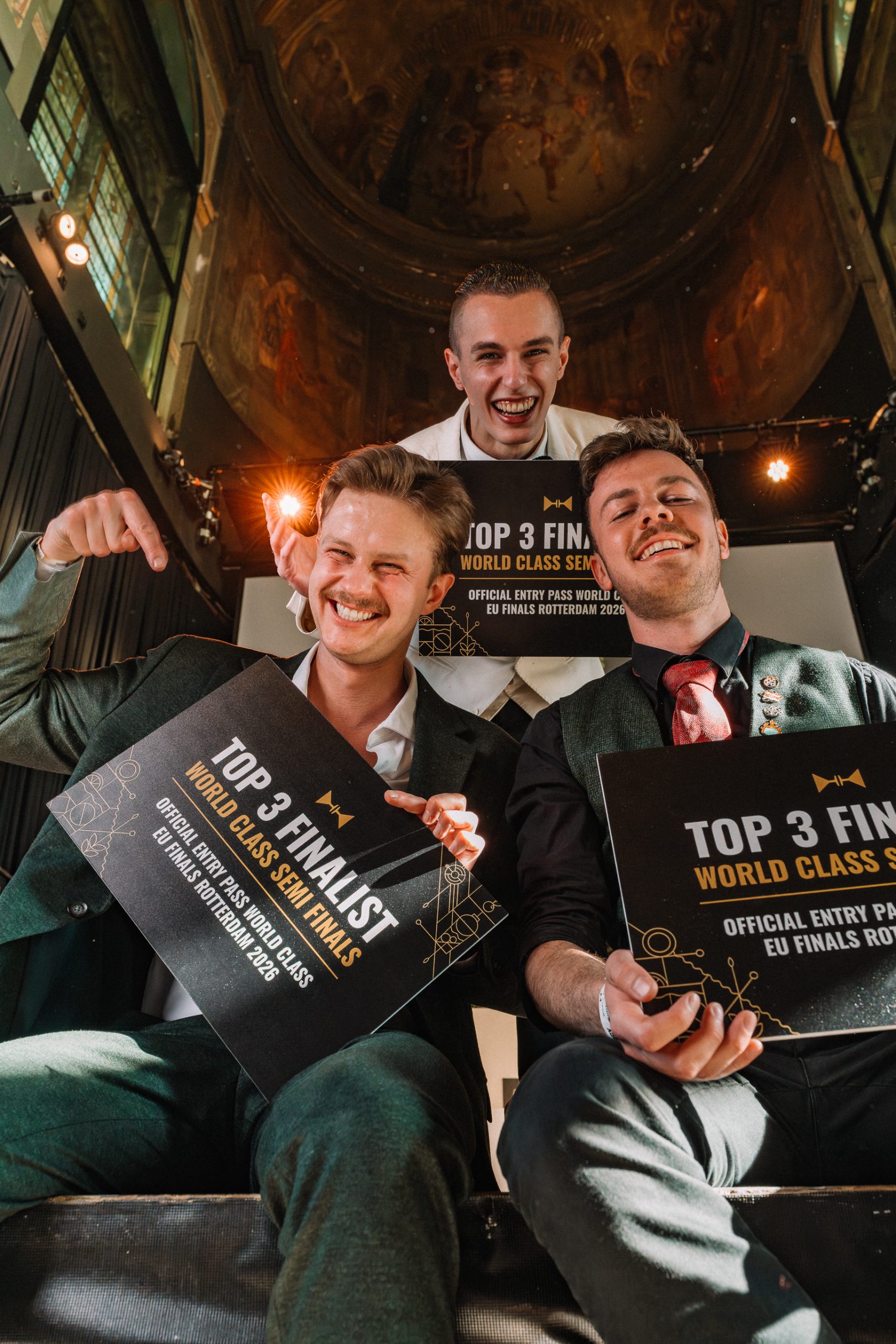
Words & photos: Albert van Beeck Calkoen
On April 21, inside Hotel Arena, the Dutch chapter of one of the world’s most influential bartending competitions unfolded once again. Diageo World Class isn’t just a contest. It’s a global stage, with national rounds across participating countries, all leading toward an international final where the very best compete at the highest level of the craft.
This particular round, the Ketel One edition, challenged the finalists to do something deceptively simple: create two coffee-based cocktails that move between contrasting rituals or moments. The brief demanded more than flavor: it asked for storytelling, atmosphere, and technical execution. Two serves, two moods, one cohesive vision. At the center of it all: Ketel One Vodka, acting as the connective thread between creativity, precision, and identity.
Setting the stage
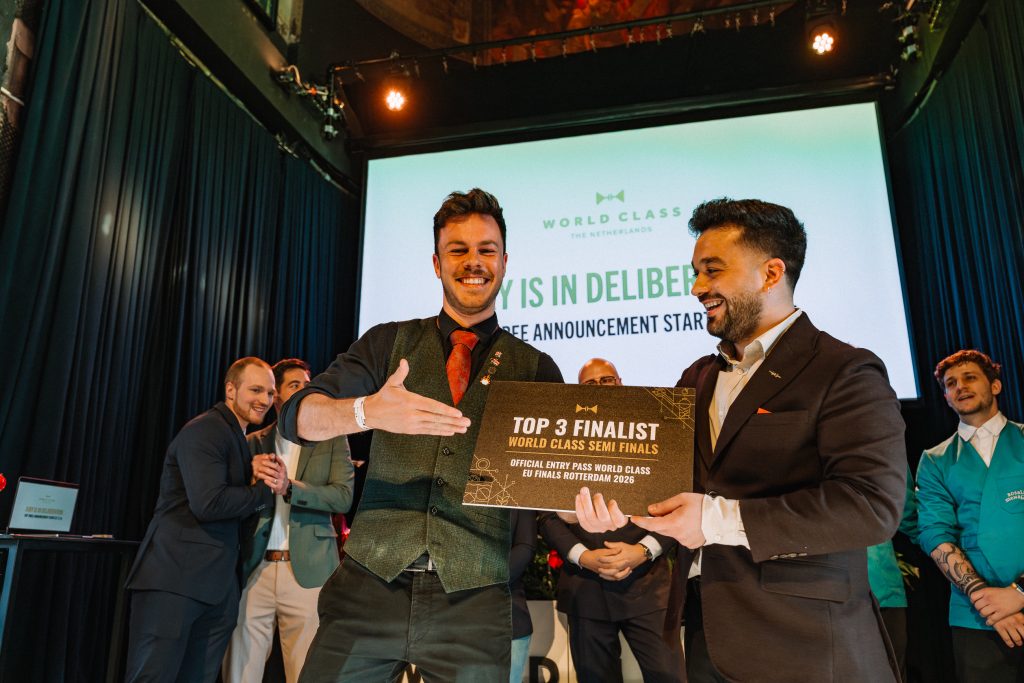
The day began with ten finalists gathering in the morning, welcomed by host Stephan Koese. Each bartender stepped forward to present not just drinks, but rituals, carefully constructed experiences designed to transport the judges between moments of the day. Evaluating them were three figures with sharply defined perspectives: Ingmar Voerman, Wendelien van Bunnik, and Halil Özgür. Together, they assessed not only taste and technique, but the clarity of concept and the ability to translate coffee into something beyond the expected. Across the morning, rituals unfolded, quiet, expressive, theatrical, and deeply personal. By the end, three names stood out. Not as first, second, or third but as finalists advancing to the national final in June.
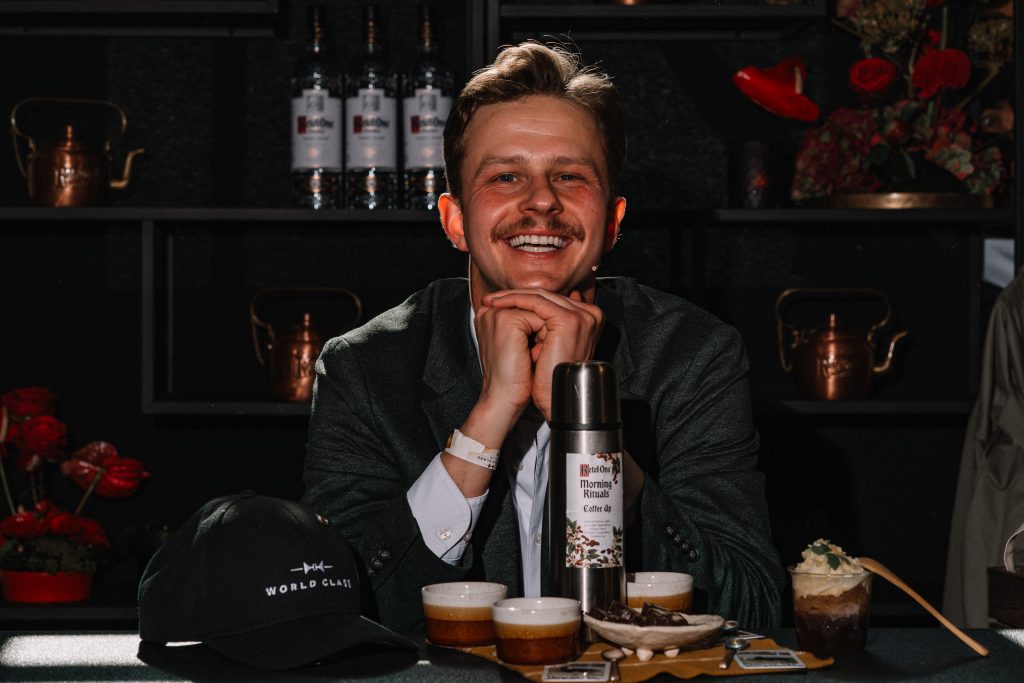
Laurynas Lazdauskas (Sonora, Amsterdam)
For Laurynas Lazdauskas, ritual begins with something simple: a morning walk, a cup of coffee, and his dog. “Most of us begin the day with a personal ritual, something small but meaningful that sets the tone,” he explains. “My mornings start with the first kiss from Amaro… followed by a coffee and a walk through the park. That quiet time grounds me.” His first serve, Coffee Up, translates that moment into a warm, comforting cocktail—served from a thermos into ceramic cups, accompanied by Tinginys, a traditional Lithuanian “lazy cake.” At its core sits acorn coffee, a nod to his heritage and a thoughtful alternative to caffeine-heavy brews. Around it, layers build: maple blossom schnapps, Amaro Montenegro, and even buckwheat soy sauce, adding a subtle umami depth. “Both Amaro and I come from Lithuania,” he says. “This drink is a way of sharing a piece of that heritage.”
Where the morning is introspective, his second serve, Coffee Out, shifts entirely. Inspired by shared dinners and connection, it blurs the line between cocktail and dessert. A frozen blend of coffee and vodka meets mascarpone and passionfruit cream, finished with Gouda crumbs and lemon cress, served with a spoon. “What if a drink isn’t just a drink and dessert isn’t just dessert?” he asks. “What if they become one?” It’s playful, textural, and deliberately social. An invitation to slow down and share.
Luca Gislon (Fitz’s Bar, Amsterdam)
For Luca Gislon, the concept of ritual is deeply personal and rooted in both daily habits and chosen family. His first serve draws from the most universal ritual of all: the morning coffee. “When I wake up in the morning, the first thing I do is drinking a coffee, like everybody,” he says. But from there, the drink becomes layered with meaning. Each ingredient is inspired by someone close to him: his “family” in the Netherlands. A southern Italian moka serves as the base, while a house-made minty mocha liqueur (clarified with mint ice cream) adds both texture and freshness. Even the bitters are crafted using leftover coffee grounds and mint stems, accelerated through ultrasonic infusion. The garnish? A bonbon made from those same repurposed elements. Everything connects and nothing is wasted.
His second serve pivots to a different kind of ritual: the moment before going out. “It’s when you spray the perfume, when you get ready,” he explains. Here, his grandmother’s Turkish heritage comes into play, with a cardamom-forward coffee extracted through a slow drip method. Clarified with miso and chili for depth, the drink is topped with an orange blossom foam made from reused coffee grounds infused into Ketel One. Even the byproducts of clarification are transformed into a simple cookie. “The challenges really push you,” he reflects. “And it’s always nice… to see friends from the industry. It’s one of my favorite parts of the competition.” His approach is both technical and emotional, precision-driven, yet anchored in memory and connection.
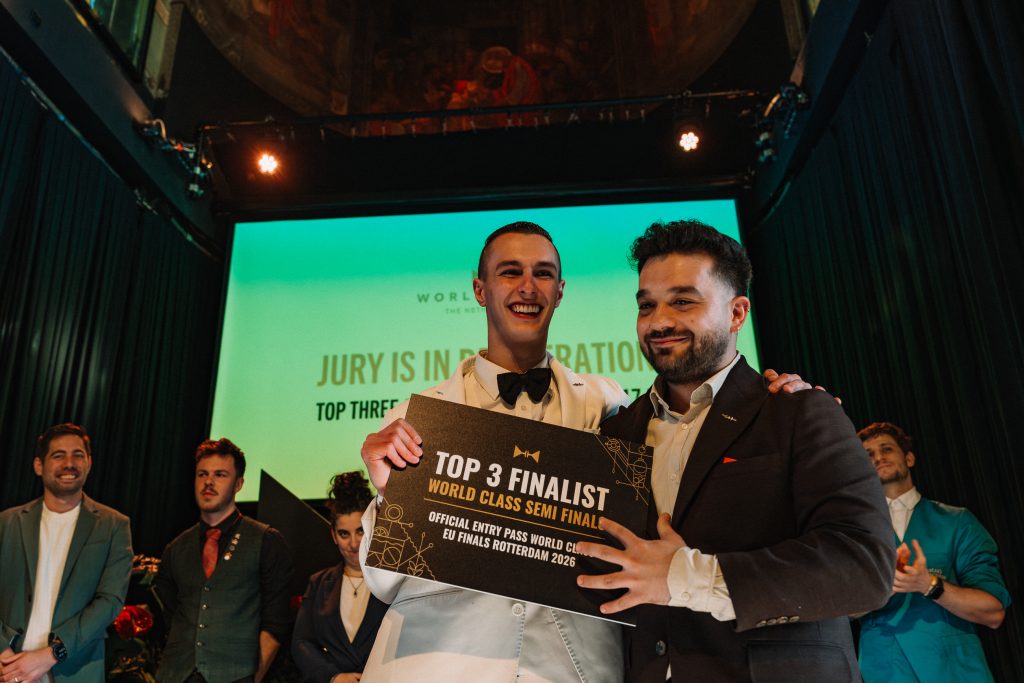
Franko Miloslavić (freelance bartender)
Where Laurynas looks inward and Luca builds through personal connections, Franko stretches his concept across time itself. “My two drinks were based around two completely different concepts that I tied together using coffee,” he explains. “I also created a custom made sound track that follows both concepts, enriching the ritual and bringing energy, and also ties them together.” The first draws from what is often considered the oldest coffee ritual in the world: the Ethiopian coffee ceremony. Coffee is brewed live, grounding the experience in tradition and origin. His homemade liqueur incorporates niter kibbeh (spiced Ethiopian butter) binding the drink together with vodka as its backbone. “The ritual part was essential,” he says. “It’s about honoring where coffee comes from.” From there, he shifts dramatically into the future.
His second serve, Cosmo 3000, explores the evolution of coffee, how it has traveled from Ethiopia to countries like Colombia, where modern cultivation unlocks new aromatic possibilities. Instead of relying on classic formats, he reimagines the ingredient entirely: redistilling coffee, extracting oils, infusing vodka, and finishing with a coffee vapor. “I decided to approach coffee in a different way, without classically putting espresso in a martini,” he explains. The result is conceptual, technical, and theatrical. A drink that reflects not just what coffee is, but what it can become. For Marko, the experience itself was just as impactful. “To be presenting in a room filled with so many good creative individuals… it was very good and very impactful,” he says. “I’m very grateful for the opportunity.”
Looking ahead
Three bartenders, three distinct perspectives, yet all aligned by the same challenge: to capture contrast, craft, and creativity through coffee, anchored by Ketel One Vodka. From Lithuanian park rituals to Italian-Turkish heritage, from Ethiopian ceremony to futuristic distillation, the range of expression on display at Hotel Arena made one thing clear: coffee, in the hands of the right bartender, is far more than an ingredient. It’s a language. And for Laurynas Lazdauskas, Luca Gislon, and Franko Miloslavić, that language has earned them a place in the national final this June, where the rituals will continue, and the stakes will only get higher.