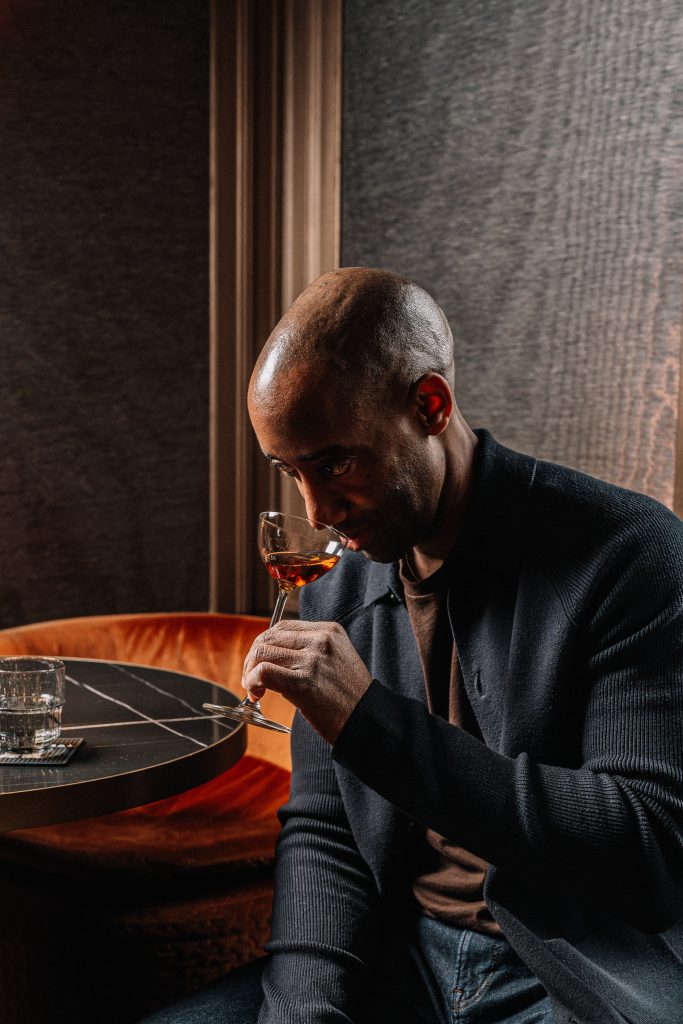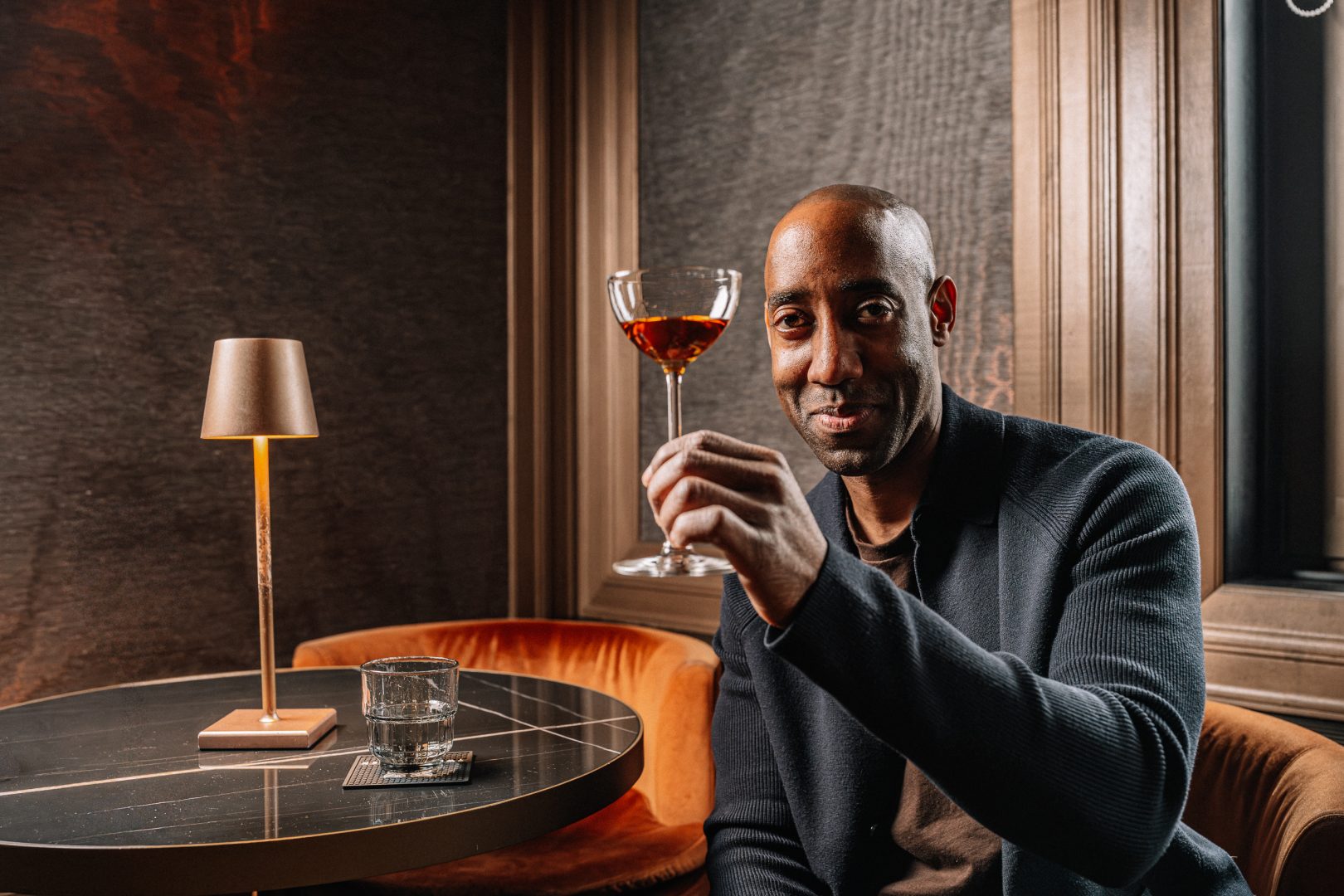
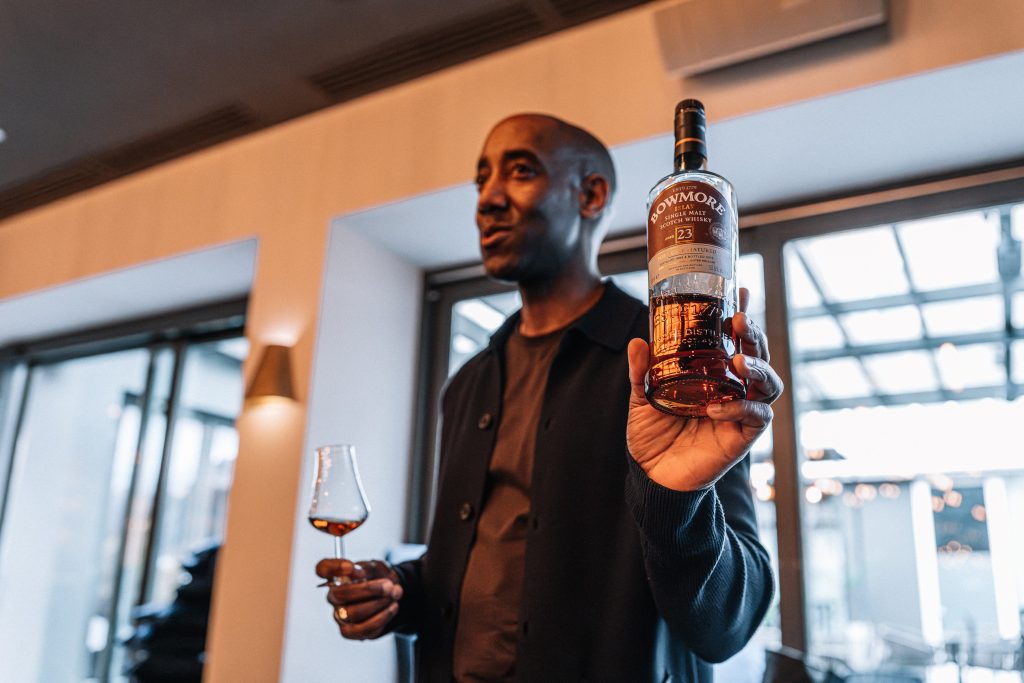
As Global Brand Ambassador for Bowmore and Laphroaig, Teddy Joseph occupies a unique position within the world of Scotch whisky. He represents two of Islay’s most iconic distilleries, both shaped by the island’s rugged coastline, peat-rich landscape, and centuries-old traditions, yet wildly different in character. Where Bowmore leans into balance and refinement, Laphroaig is unapologetically bold, medicinal, and intense. Bridging those identities and translating them for a global audience is at the heart of his role.
From hospitality to global ambassador
Teddy’s path into whisky wasn’t linear. He began in hospitality, working behind bars and gradually moving into management before opening his own speakeasy-style cocktail bar in Edinburgh. At the time one of the first venues in the city to focus on a seated, table-service experience. While the concept helped push the local scene forward, the venue itself didn’t last. A move into drinks sales followed, after relocating to London, where Joseph discovered that his strength wasn’t in hard selling, but in storytelling, educating people, sharing knowledge, and creating genuine connections around the brands he represented. That ability ultimately paved the way into his current role as a global ambassador.
Breaking the Islay misconception
One of the biggest challenges he encounters today is perception, particularly when it comes to Islay whisky.
“There’s a common misconception that all Islay whiskies are the same,” he explains. “Someone might try Laphroaig first, something very bold, very intense, and if they’re not ready for that level of peat, they assume every Islay whisky, or even every Scotch, is like that.” That first encounter can be decisive, but also misleading. “The reality is there’s a whole spectrum of flavors and styles. Sometimes that first whisky just wasn’t the right fit.” This is where the contrast between his two brands becomes a powerful storytelling tool. “With Bowmore, we talk about balance. It still has that signature Islay smokiness, but it’s more moderate. We measure that in phenols, parts per million. Bowmore sits around 25 to 30 PPM, whereas Laphroaig is closer to 55. That’s a significant difference, and it gives you a clear indication of what to expect.”
A spectrum, not a single style
That spectrum, between subtle smoke and full intensity, helps reframe Islay not as a singular style, but as a diverse category. At the same time, Teddy sees a shift in how whisky is being approached by a new generation of drinkers, one that’s less bound by tradition and more open to exploration. “Heritage gives people confidence,” he says. “With Bowmore, we often say it’s the original Islay single malt, established in 1779, and the second oldest distillery in Scotland. That history matters. It tells people this is something worth paying attention to.” Laphroaig, too, carries its own weight. “It’s instantly recognizable: its flavor, its aroma, even its packaging. And Laphroaig 10 is still the biggest-selling Islay single malt. That identity really grabs people.”
Making whisky more accessible
But heritage alone isn’t enough. Accessibility is key and that’s where the way whisky is served comes into play. “I always say there’s no wrong way to drink whisky,” Teddy explains. “For a lot of people, the best entry point isn’t neat, it’s through a cocktail.” Whether it’s a highball, an aperitif-style serve, or something more complex, cocktails provide a more approachable gateway into the category. “It helps break down that barrier where people say, ‘I don’t drink whisky.’ If you’re enjoying it in a cocktail, you are enjoying whisky. Just in a different format.” That shift in mindset is crucial. “There’s this idea that whisky has to be enjoyed neat, in a Glencairn glass, in a leather chair. But it doesn’t. It can be long, refreshing, mixed. Whatever works for you.”
Over time, he adds, palates evolve. “People might start exploring those flavors more directly, but it doesn’t have to begin there.”
Life on the road
Behind the scenes, however, the role of a global ambassador is far more demanding than it might appear. “People see the travel and think it’s amazing and it is, I love it,” he says. “But it’s also very taxing. You’re constantly adjusting to new time zones, then going straight into presentations where you have to be focused and engaging.” And the work doesn’t stop when the presentation ends. “You’re still hosting, still interacting, still representing the brand. By the time you get back to your hotel, there’s a real drop in energy after that adrenaline wears off.”
Discipline over indulgence
Another misconception is the idea of constant indulgence. “People think you’re just drinking all the time. In reality, you have to be the most restrained person in the room. You’re there to do a job.” Professionalism, he stresses, is everything. “You’re the face of the brand. It’s not a 24-hour party. You need to stay sharp, look after yourself, and be aware that everything you do reflects on the company.”
Sharing knowledge, not showing it
Despite the intensity, it’s the connection with people and the responsibility to communicate something meaningful that keeps him motivated. “I still get nervous every time I present,” he admits. “And I think that’s important. It means I care. The moment that disappears, there’s a problem.” For Joseph, success isn’t measured by how much he knows, but by what his audience takes away. “It’s not about me. It’s about what I can give people. If someone walks away with one piece of information they didn’t have before, something they can share with someone else, that’s a win.” In the end, whether he’s pouring a bold dram of Laphroaig or introducing someone to the more balanced side of Bowmore, the goal remains the same: to open the door to whisky, one conversation at a time.
This article was made in collaboration with Suntory The Netherlands, part of Koninklijke De Kuyper.