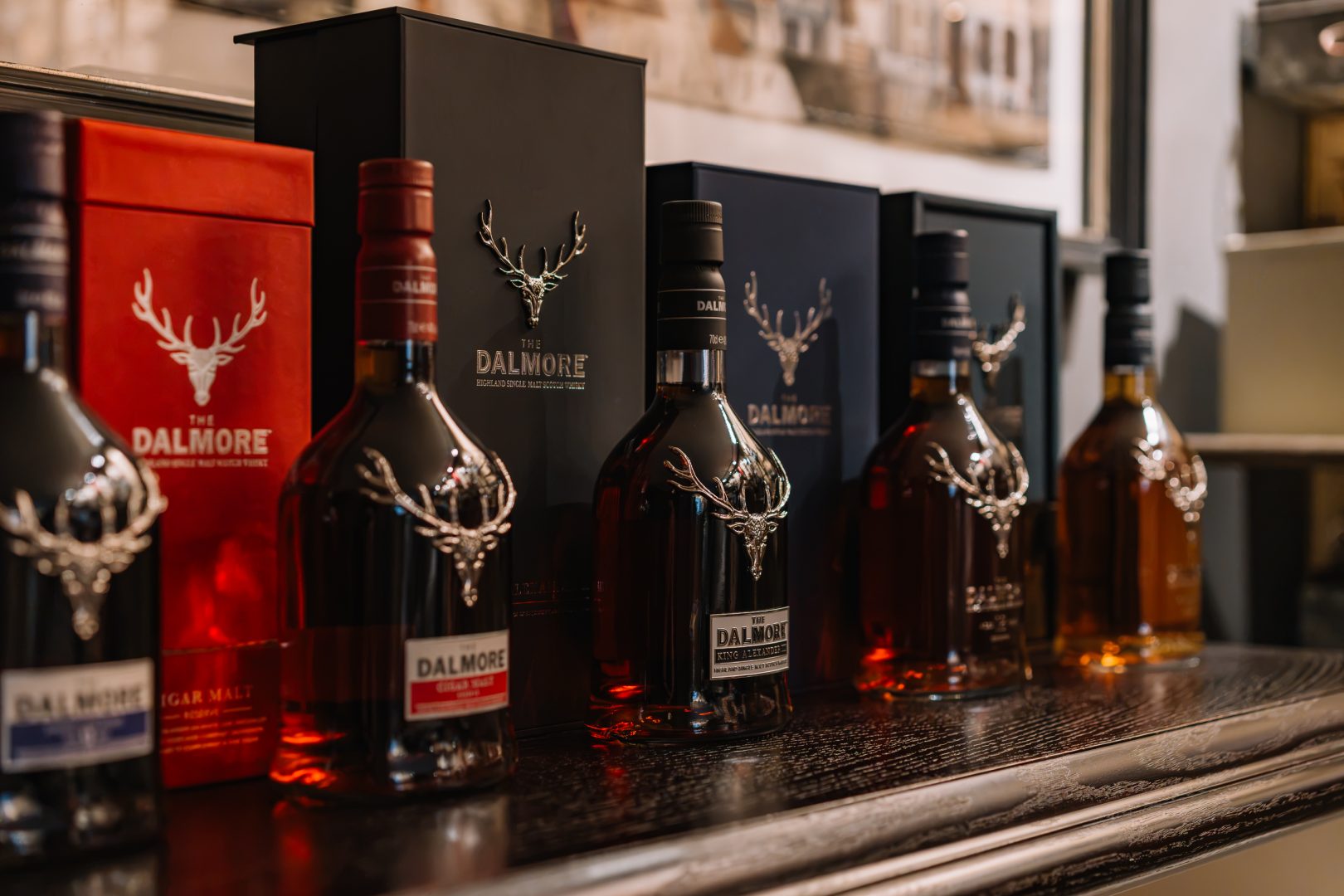
Behind a wall of old safe-deposit boxes in Amsterdam, The Vault Bar opened its Tasting Series with The Dalmore: five Highland single malts, five plates from chef Pasquale Carfora, and one bottle nobody expected.
A Rob Roy to break the ice
The evening started the way a good bar evening should, with a drink in hand before anyone had to concentrate. Ignazio Di Gangi, manager of The Vault Bar, welcomed the table with a house twist on the Rob Roy built on The Dalmore Port Wood Reserve. The bar makes its own vermouth for it, starting from an orange wine, and finishes the drink with a perfume of orange. For Ignazio, the format matters as much as the liquid. The Tasting Series is meant to give the concept of The Vault a deeper layer and to share some of the culture behind the bottles on its shelves. This first edition was built around one brand, one host and one kitchen. The host was Toon de Gier, who has spent almost eight years as brand ambassador for the single malts of Whyte & Mackay: The Dalmore, Jura, Tamnavulin and Fettercairn. Most of his evenings look like this one, a room of twenty or thirty people working through one brand from start to finish. “That is the best way to get to know a brand,” he says, “because you compare the whiskies to each other, and you learn where the flavours, the quality and the price come from.” He promised to keep the jargon for the whisky geeks. “Whisky is made to enjoy, not to overthink.”

A ritual, not a rulebook
Before the first pour, Toon shared the one habit he never skips. Taste every whisky the same way, every time, so that the only thing that changes is the whisky. Swirl, nose with small sniffs, and switch between nostrils, because each one picks up different aromas. “One side I get more sweetness, the other more alcohol. The next day it can be the other way around.” Then the rule of thumb that got the biggest laugh of the night: hold the whisky in your mouth for one second per year of age. A 12 Year Old gets twelve seconds. Your body warms it up, more flavour comes out, and you breathe out through your nose rather than your mouth to avoid the alcohol vapours. Water is allowed, with one condition. Taste it neat first, then add the same number of drops every time. “If your ritual is three drops, always do three drops. After that, add as much water or ice as you want. How you taste should never change. How you drink depends on your moment.”
The stag on the bottle
Every bottle on the table carried the same silver twelve-point stag, and Toon took a moment to explain why. In 1263, during a royal hunt, King Alexander III of Scotland was charged by a stag. Colin of Kintail, chief of the Mackenzie clan, stepped in and killed it. As thanks, the king granted him land, the motto Luceo non uro (“I shine, not burn”) and the right to carry the royal stag on the clan’s coat of arms. The distillery came much later. Sir Alexander Matheson founded it in 1839 on the banks of the Cromarty Firth, north of Inverness, looking out over the Black Isle where much of its barley still grows. In 1867 the Mackenzie brothers, descendants of Colin, took over and put the stag on the whisky. “It stands for not being afraid to step forward,” Toon says. “Our master blenders were never afraid to do things a little differently.” That appetite for long ageing goes back further than most people think. Toon showed a record of a whisky bonded in 1868, aged twelve years in oak and eleven more in sherry, then bottled in 1891 as a 23 Year Old. A 1915 letter documents sherry casks bought from González Byass, a relationship that still supplies Dalmore today. The distillery has just finished a major rebuild. The new still house copies the original one still for still, including the flat-topped wash stills and the unusual horizontal condensers, so the spirit comes out the same while capacity roughly doubles. The philosophy stays the one Toon repeats all evening: a Dalmore is not ready when the timer goes off. It is ready when it is perfect.
Course one: 12 Year Old Sherry Cask Select
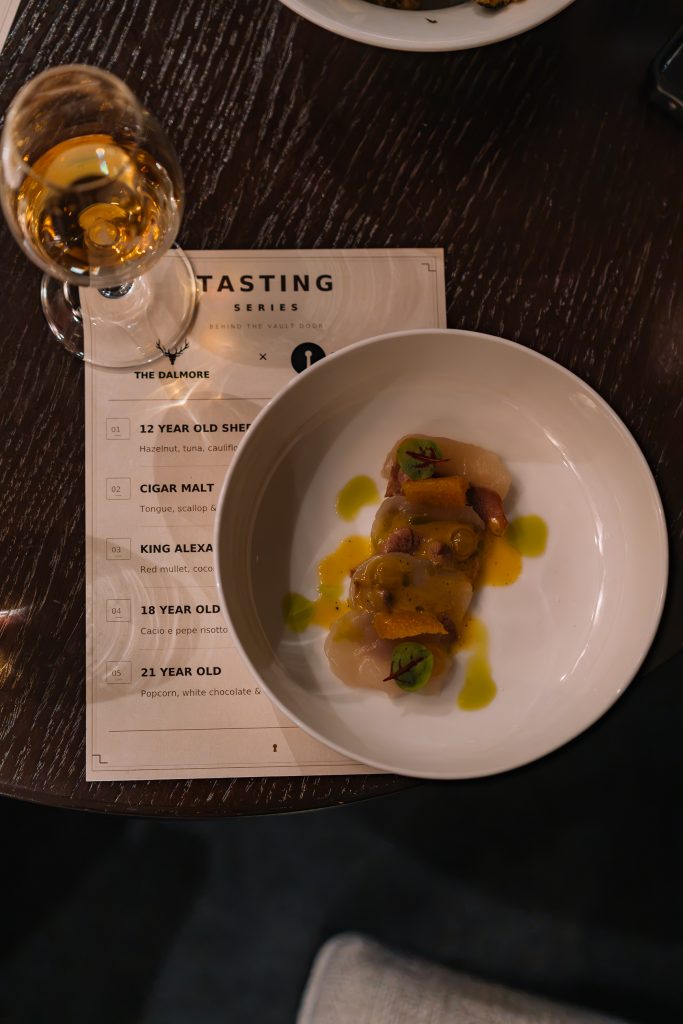
On the plate: hazelnut, tuna, cauliflower and bottarga
The opener was not the classic Dalmore 12 that most people know, but its less common sibling. Both start in ex-bourbon casks, which give Dalmore its caramel and vanilla base. Where the standard 12 sends only half its whisky into oloroso casks, the Sherry Cask Select finishes all of it in sherry casks. Those come from cooperages in Jerez that build casks to Dalmore’s specification and season them for about two years with sherry made for the purpose, mostly sweetened oloroso, sometimes dry oloroso or PX. The result shifts the house style. “The normal 12 is way more orange-forward,” Toon explains. “This one has more of the purple notes,” the dark, jammy sweetness of the purple sweets you buy at a funfair. Around the table, the first word was caramel, and Toon nodded: caramel, vanilla, citrus in some form and a touch of chocolate run through every Dalmore. Chef Pasquale Carfora built the first plate around the season. Cauliflower came in several textures, with a little sweetness from tonka bean, Sicilian bottarga for salinity and a hint of smoke from the grill. Salt, smoke and a touch of sweetness on the plate, sherry fruit and caramel in the glass: a gentle way to open five courses.
Course two: Cigar Malt Reserve
On the plate: tongue, scallop and mandarin
This whisky exists because of one man’s favourite smoke. Richard Paterson, Dalmore’s long-serving master blender, is a fine cigar connoisseur, and he wanted a malt to sit next to a Cuban Partagás Serie D No. 4. The surprise is that it is not smoky at all. “A smoky whiskey with a smoky cigar is not gastronomic perfection,” Toon says. “You’d rather add a little sweetness, like a dessert wine, a port or a sherry.” The recipe follows that logic. After the bourbon cask start, about 20 percent stays in bourbon, 70 percent goes into Matusalem oloroso casks (30-year-old sherry, and some of the rarest casks Dalmore gets) and 10 percent into Cabernet Sauvignon barrels from Bordeaux. Toon calls it the most tropical and creamy whisky Dalmore makes today, with banana coming forward and a soft, creamy finish. It also changes with temperature: “Chilled, the fruity flavours come through. Warmer, the red fruit notes.” Chef Carfora admitted this pairing was “a little bit crazy, but super interesting.” Tongue and scallop with a mandarin dressing sound like an odd couple, yet the buttery texture of the scallop and the acidity of the mandarin reduction met the slight sweetness of the whisky head-on. “Unusual,” one guest concluded, “but it works.” The only thing missing was the cigar itself. Smoking indoors is not allowed, but The Vault has a private garden and tea house where it is, and before the next pour the table had already sketched out a future evening of whisky and cigars.
Course three: King Alexander III
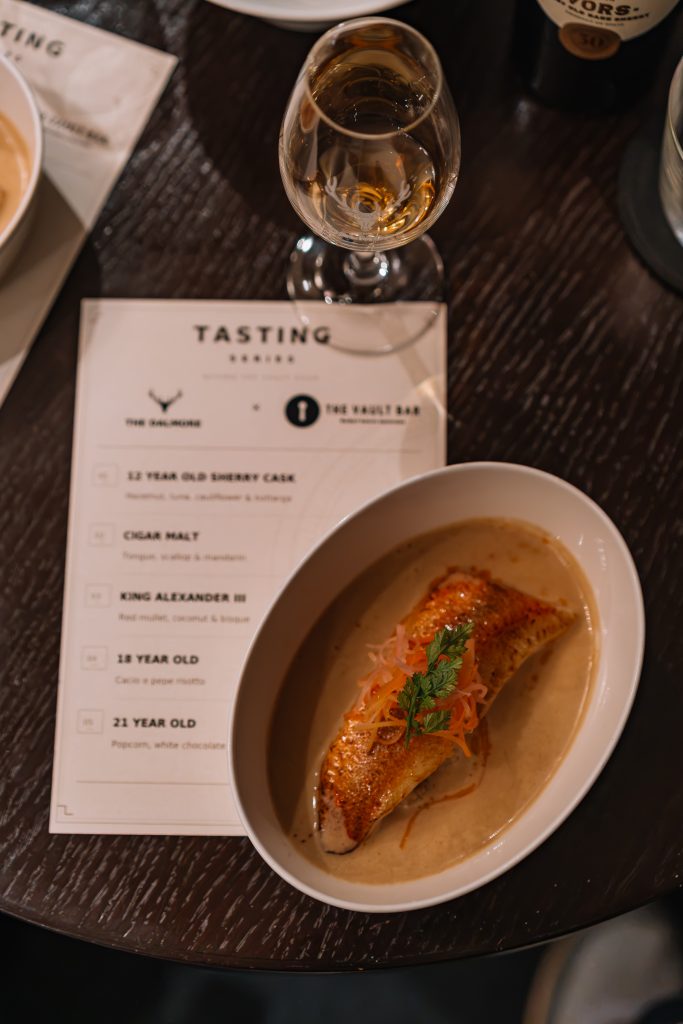
On the plate: red mullet, Dutch shrimp, coconut bisque and pickled carrot
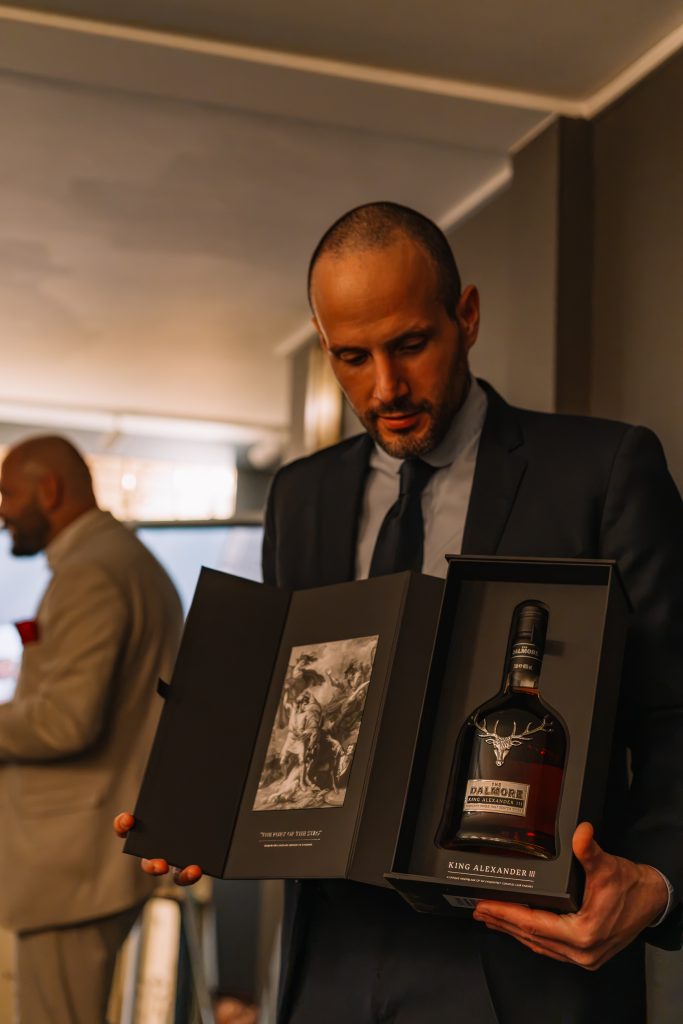
Ignazio carried this one to the table in its presentation box, the bottle on one side and a reproduction of The Fury of the Stag, Benjamin West’s painting of the 1263 hunt, on the other. “This is an icon,” Toon says. “Just as that painting is one of the most famous in Scotland, this is one of the most famous whiskies in Scotland.” Created close to twenty years ago, King Alexander III was the first single malt finished in six different cask types. After bourbon maturation, the whisky is split across small batch bourbon casks, Matusalem oloroso sherry casks, Madeira, Marsala, tawny port pipes and Cabernet Sauvignon barrels, then married back together. Six whiskies become one, and the result is complex without being hard work. “Most very complex whiskies are hard to get through,” Toon says. “If you put this on the table at a wedding, everybody will like it.” Dalmore’s global ambassador, he adds, likes to throw the cork away once the bottle is open. Temperature is the trick here. Cooler, the whisky shows passion fruit and red berries; warmer, cinnamon, nutmeg and crushed almonds. Toon once paired it with a foie gras and apple starter at a two-star Michelin dinner and chilled the bottle for half an hour first, so the tropical notes would meet the dish rather than overpower it. On this night it met red mullet in a coconut bisque with Dutch shrimp and pickled carrot. Rich coconut and seafood depth on the plate, layers of wine-cask fruit and spice in the glass. The pour also sparked the night’s best bar talk. A guest wondered how King Alexander III would work in a French 75 at zero degrees. Ignazio’s answer was a Kir Royale-style build, a short measure of the whisky topped with champagne, and Toon pointed to an old Dalmore classic: a sugar cube, a few dashes of bitters, King Alexander III and champagne.
Course four: 18 Year Old
On the plate: cacio e pepe risotto
For Toon, the 18 Year Old is where Dalmore moves up a gear. It is the starting point of the older whiskies, the age where “the vintage notes come through”: fuller body, more savoury depth, dried fruit and raisin alongside the house citrus. After a long bourbon cask maturation, it gets a full finish of up to four years in Matusalem oloroso casks, Dalmore’s best sherry wood. The bottle states a minimum of 18 years, but older whisky goes in too, so each yearly batch stays close to the last. It is bottled at 43%, a deliberate choice. “This whisky is not made to knock the whisky nerd off his socks,” Toon says. “Dalmore is hardly ever made for that. It is made to pair perfectly with a Michelin star dinner.” Chef Carfora took that literally and went home to Italy for the plate: a cacio e pepe risotto, all pecorino, black pepper and starch. Cheese and pepper against savoury sherry and dried fruit is a classic pairing logic, and at this table it won over at least one guest, who called the 18 “so far my favourite.” Toon used the moment for his most practical advice of the night. Whisky with food does not need to be complicated. “If you like Cheetos with your whisky, it’s a good combination,” he laughs. The point is to try. People stick to chocolate, nuts or smoked salmon, which are classics, “but not always the best thing.”
Course five: 21 Year Old
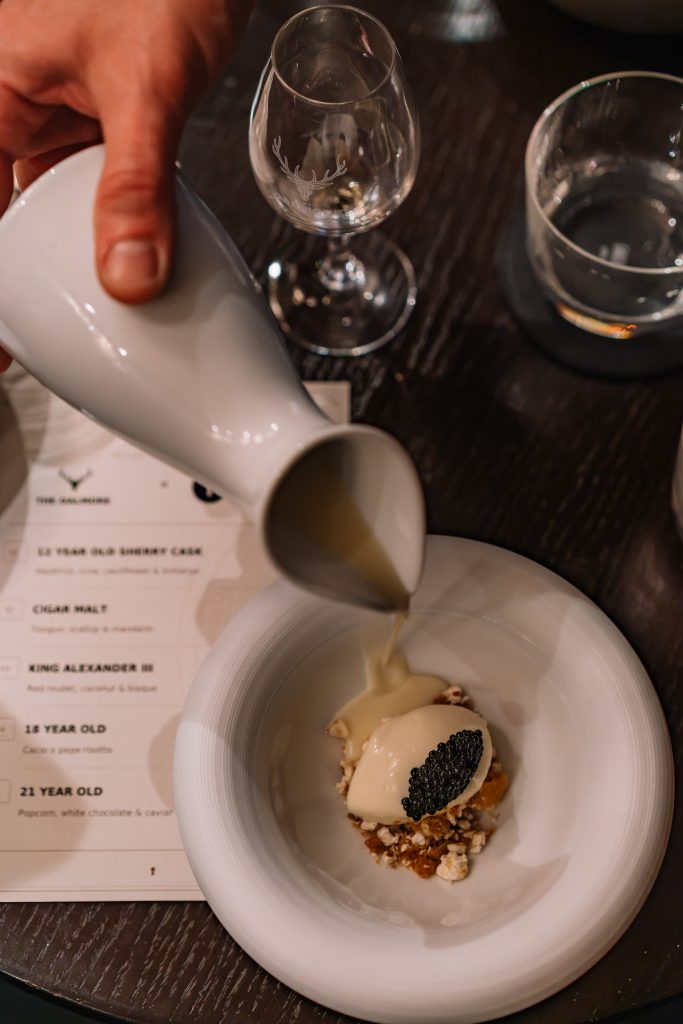
On the plate: caramel crumble, popcorn, white chocolate and caviar
You might expect a 21 Year Old to be darker and heavier than an 18. This one is paler. It follows the same route, bourbon casks and then a finish in Matusalem oloroso, but with a longer bourbon stage and a shorter time in sherry. “It will be lighter than the 18,” Toon explains. “Prettier.” Depending on the temperature, passion fruit appears, alongside the savoury, vintage flavours “you will never get in a young whisky. They are not hard to taste, but hard to describe.” That lighter profile split the table, which made for the best discussion of the night. Some missed the bold, savoury weight of the 18. Others preferred the 21 for exactly the opposite reason: fresher, livelier, a little sharper on the palate. Neither side moved. Then came dessert. Carfora layered a caramel crumble and popcorn under a white chocolate and Dalmore sauce, poured at the table, crowned with caviar. Sweet, salty, creamy and briny at once, built around the caramel and vanilla that run through the whisky. Toon’s rule for pairing at home fits this plate perfectly: read the tasting notes on the back of the box and cook to them. “If it says caramel, go caramel. If it says orchard fruit, go apples and pears.” With desserts, he adds, the Dalmore palette is easy: caramel, orange, vanilla, chocolate. “If it’s in there, go for it.”
Encore: the 25 Year Old
Five whiskies were on the menu. A sixth came out anyway. The Dalmore 25 Year Old belongs to the brand’s rare and aged range, matured in bourbon casks and then split between sherry and port casks before it comes back together. Even for Toon it is a rare pour: he serves it at only two or three masterclasses a year. Around the table, the word that kept coming back was “vintage.” It was a fitting close, and a hint of what lies above. Dalmore’s range climbs from the core whiskies up to 21 years, through the rare and aged expressions, to crystal decanters with silver stags and the four-part Cask Curation series, which explores the brand’s partnerships with cask suppliers such as González Byass in Jerez and Graham’s in Porto. “If we can make this,” Toon says of the top of the range, “our entry-level whiskies must be perfect as well.”
What’s next at The Vault
For Ignazio, this first edition proved the format. Pairing a spirit with food is becoming a trend, he says, especially in South America, and The Vault wants to bring that level of detail to Amsterdam. Cocktails are the harder next step: “With a cocktail it is more difficult than with a classic spirit. One element, and boom, you destroy everything.” The plan is to build it step by step. And judging by the talk at the table, a whisky and cigar evening in the garden is already on the list.